Aperture / Afterimage
Note: This performance uses haze and strobe lighting effects.
A study in perception lag and visual residue.
A new original audiovisual installation curated by Buffalo-based artist collective Groupwork, part of the IN.SIGHT series — an ongoing investigation into technology-mediated expression and embodied systems of code, light, sound, and space.
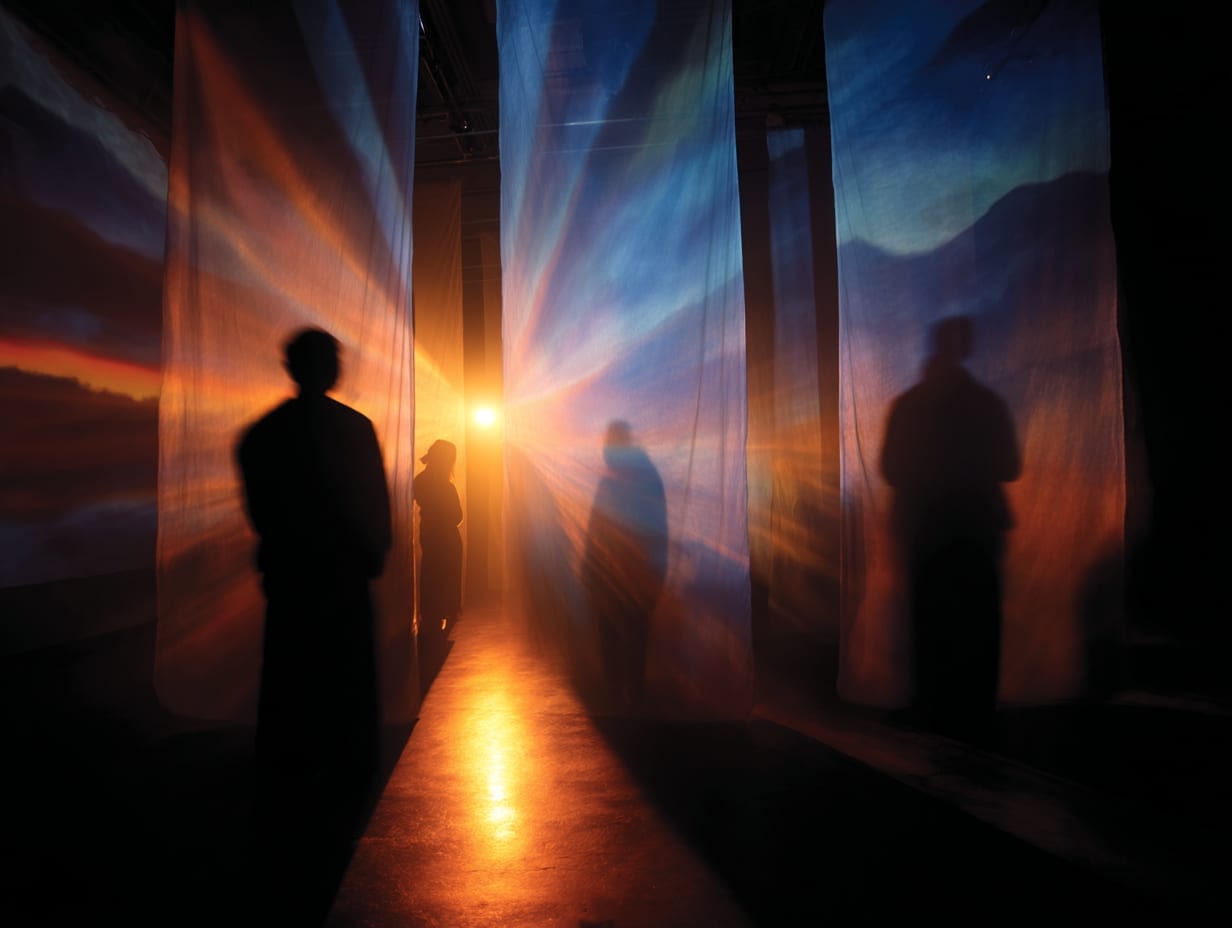
Aperture / Afterimage explores how light imprints itself on the body. The work investigates the delay between stimulus and memory, using high-contrast lighting, rhythmic pulses, and subtle motion to create perceptual echo. It continues Groupwork's exploration of shared experience, generative systems, and memory as a living process.
Related work
Documentation
Concept
An aperture opens. Light enters. It leaves a trace. The afterimage persists longer than the source.
This work focuses on thresholds: emergence, disappearance, retinal memory, and the psychological space between seeing and understanding.
System / Method
- Controlled lighting sequences with calibrated intensity shifts
- High-contrast color transitions
- Haze and strobe used to extend light through the room and mark temporal thresholds
- Minimal sound structures emphasizing tonal continuity
- Temporal spacing designed to amplify perceptual lag
Spatial Experience
This is a seated experience. The work is oriented toward peripheral vision — visitors are invited to notice both the source of light and what gathers at the edge of sight. Less a spectacle to be consumed than a condition to inhabit. The room becomes a camera body. The audience becomes a sensor array. The work unfolds slowly enough that viewers begin to notice what their own eyes are doing. Aperture / Afterimage leaves the audience slightly out of sync with ordinary time.